Biological context
Whole-blood fatty acids · nutritional context

Adaptive Performance
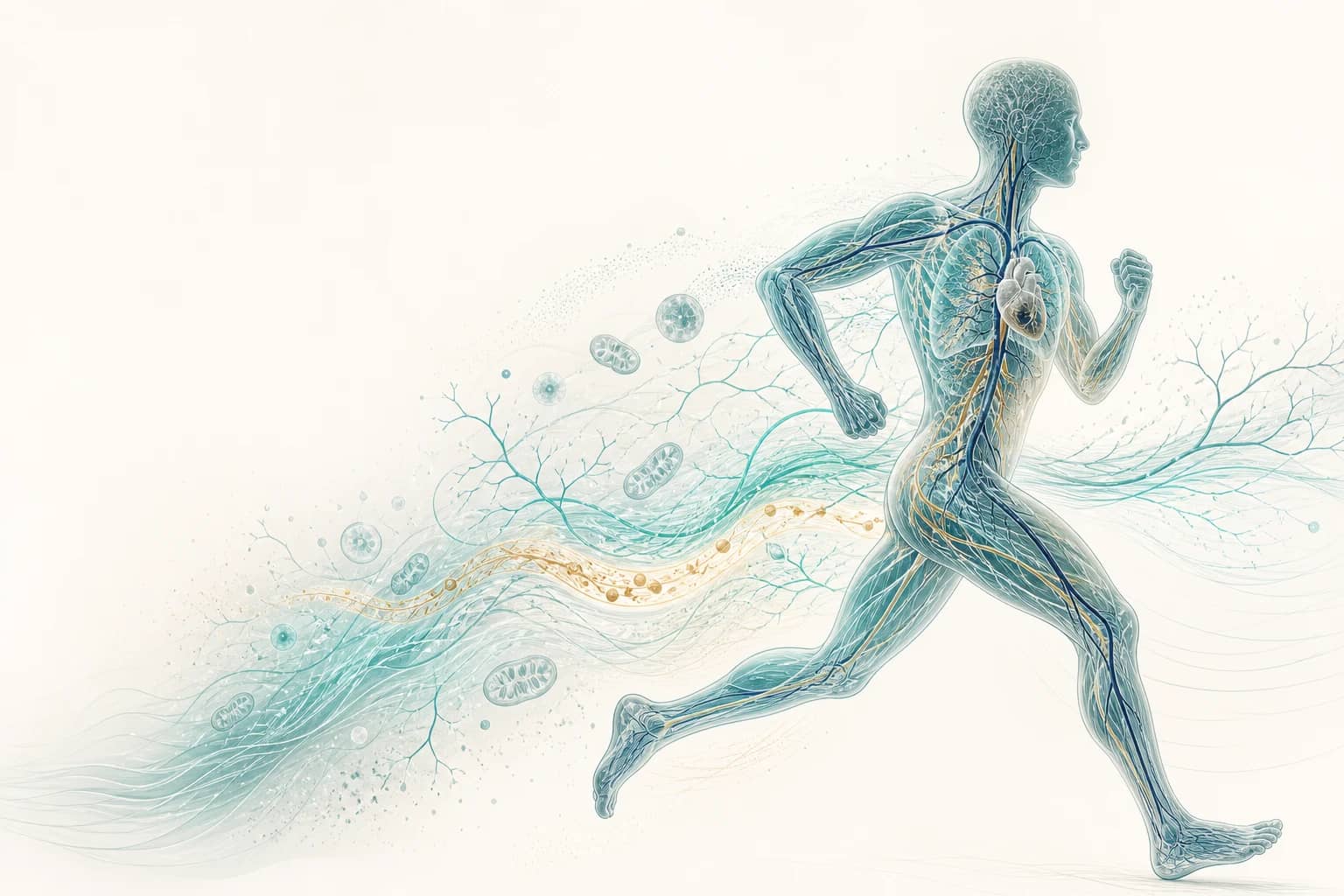
Training provides the stimulus. Performance reflects the result. ECS Restore explores the biological states and physiological responses that determine what happens between them.
Are you an athlete or coach curious about data-driven training and how biological state shapes the response to exercise? We welcome exploratory conversations at every level, from amateur to elite.
Share your interestConceptual framework
Substrate biology · sleep/autonomics · metabolic phenotype
Training load · duration · intensity
HR · lactate · substrate utilisation
Sleep architecture · autonomic reorganisation
VO₂ · thresholds · fat oxidation · performance capacity
Performance is the visible endpoint. Adaptive physiology is the process that produces it.
Phenotype, not a score
Adaptive capacity emerges from interacting biological, metabolic, autonomic and neural systems. We do not reduce that complexity to a single proprietary score.
Whole-blood fatty acids · nutritional context
VO₂ · VCO₂ · RER · MFO · lactate
Resting physiology · sleep-stage HRV
Sleep architecture · EEG-derived features
Change following defined challenge
Exercise as perturbation
Exercise can be understood as a repeated exogenous physiological perturbation. The question is not simply what work was prescribed, but how physiology responds, recovers and changes when the challenge is repeated.
Training load, duration and intensity are specified.
Heart rate, lactate and substrate utilisation describe the immediate response.
Sleep and autonomic physiology provide a longitudinal recovery context.
Functional capacity is re-measured over time.
This is a conceptual application of state-dependent physiology, not a claim that any individual measurement is ECS-specific.
Independent scientific precedent
A 2026 human skeletal-muscle study used transcriptomics, lipidomics and metabolomics before and after acute exercise. In trained older adults, about 50% of the age-related molecular differences observed between young and normally active older adults were absent, particularly across energy-metabolism and cellular-respiration pathways. Among older adults, physical fitness was positively associated with the magnitude of exercise-induced transcriptional immune/stress responses. [AC1]
That distinction—state versus response—is central to the ECS Restore approach.
Explore the scientific framework →Experimental recovery phenotype
Sleep Autonomic Gain is an exploratory construct for describing state-dependent autonomic responsiveness around comparable sleep transitions. It is not presented here as a CB1 biomarker.
State-response coupling across one night
Sleep provides repeated physiological perturbations. Autonomic physiology reorganises around those transitions; the construct asks about the magnitude, latency, coherence and reproducibility of that response.
03 · State-response coupling
A candidate phenotype of state-dependent autonomic responsiveness.
Candidate construct—not a validated biomarker, clinical score or direct measure of CB1 physiology.
COMPARABLE STATE TRANSITION · DIFFERENT RESPONSE
A smaller or less coordinated autonomic shift follows the same sleep-state change.
A larger, more coherent autonomic shift follows the same sleep-state change.
Exploratory observation
Personal data · descriptiveIn this example, RMSSD was 50–70 ms during a three-minute awake rest recording and 100–140 ms during N2 sleep.
Descriptive within-person ranges. Awake rest and N2 are different recording contexts; this observation motivated the state-response hypothesis but does not by itself estimate Sleep Autonomic Gain.
Scientific boundary
Exploratory physiological construct. Sleep Autonomic Gain describes state-dependent autonomic responsiveness during sleep. Whether this construct provides reproducible information about adaptive capacity or CB1-associated physiology requires prospective validation.
Athlete 001
An exploratory N-of-1 description of observations accrued across changing biological, training and intervention contexts.
View the case study →Measured readout
62.7 ml·kg⁻¹·min⁻¹
Laboratory-confirmed VO₂peak
Longitudinal
observation
Metabolic phenotype
~1.0 g/min fat oxidation near provisional LT2 HR
Autonomic physiology
Longitudinal resting and sleep-stage observations
Biological context
Longitudinal whole-blood fatty-acid remodelling
This case describes observations during a multicomponent intervention and structured training period. It does not establish that ECS Restore, any individual intervention, or altered ECS/CB1 signalling caused the observed changes.
Individual Performance Collaboration
We would like to hear from athletes—amateur or elite—and coaches who enjoy data-driven training and are curious about state-dependent exercise: how a person's biological state may shape their response to a given training stimulus.
This is an invitation to explore ideas and potential measurement-led collaboration, not an active coaching programme. We are interested in the questions athletes and their coaches want to investigate around training, recovery and adaptation.
Any future work would be shaped with the athlete and, where relevant, their coach and existing clinical or performance team. The aim is to add a thoughtful physiological perspective, not replace the people already supporting them.
Performance Collaboration
For researchers, laboratories, technology organisations and scientific partners developing the evidence, methods and measurement infrastructure around adaptive physiology.
Develop methods, validation studies and prospective research questions.
Start a conversation →Build rigorous measurement pathways and shared approaches to interpretation.
Start a conversation →Develop interoperable tools for longitudinal physiological observation.
Start a conversation →